Intelligent Systems · Project P4 · November 2026
Learned delivery routing
A neural network, a constraint solver and A* search, working as one system on real NYC taxi data.
Moaz Hassan El-GarawanyID 320240032 · AID S1
Ahmed Hossam El-dinID 320240051 · AID S1
1ProblemMoaz
Three questions every dispatcher asks.
HOW LONG?
Neural network
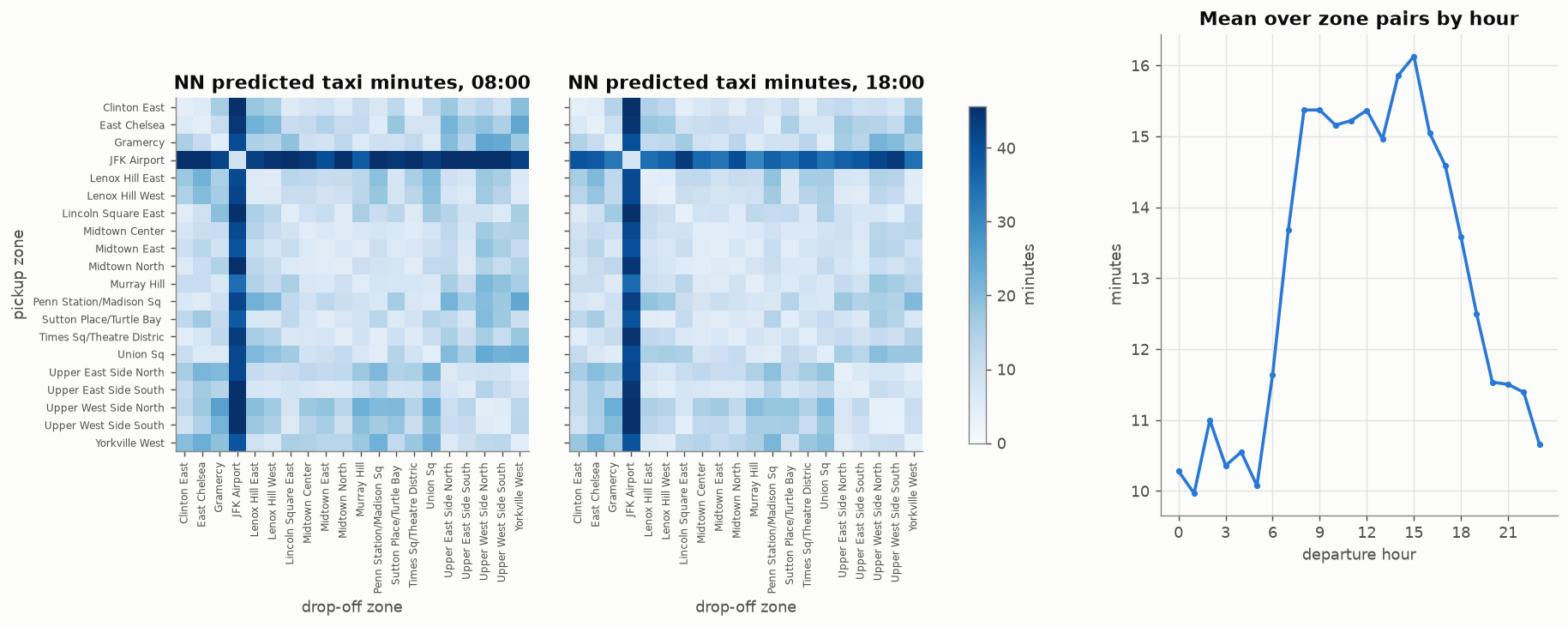
Predicts trip minutes between zones from pickup, drop-off, hour, weekday and distance → a 24 × 20 × 20 time matrix.
→
WHICH VAN?
CSP
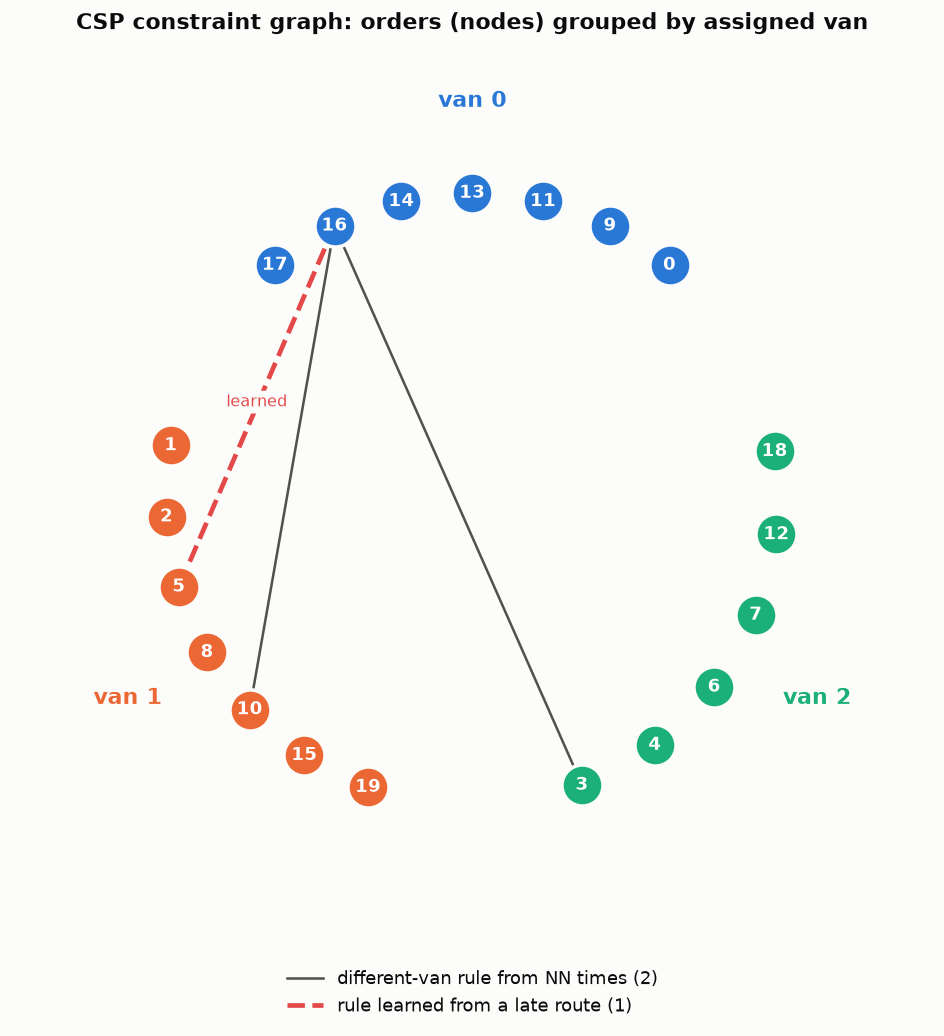
Van per order. Windows reachable, capacity, ≤ 10 stops, and "different van" pairs from the NN times.
→
WHAT ORDER?
A* search
(stop, visited, clock). Cost = travel + waiting. Admissible time-dependent heuristic.
↺ Feedback loop: a late route turns its first late pair into a new "different van" rule, and the CSP runs again (up to 5 loops).
2DataMoaz
Real trips, generated orders.
- NYC TLC yellow taxi trips, January 2022: 2.46 M trips.
- Weekdays, 1 to 120 minutes, the 20 busiest zones (19 Manhattan + JFK): about 300 k trips.
- Split by day: 3 weeks train, last week test (93,592 trips).
- Orders, windows, demands and capacities are generated with a seed.
- Taxi ≠ van: a documented van factor of 1.2.
2.46 Mraw trips
≈ 300 kafter filtering
20zones
93,592held-out test trips
3Neural networkMoaz
A hand-written MLP that learns the city's clock.
- Inputs: pickup zone, drop-off zone, hour, weekday, pair distance.
- Plain numpy: Adam, Huber loss, early stopping (best epoch 9 of 14).
- Output used by the planner: the hourly zone-to-zone time matrix. Note JFK's row and the afternoon peak.
4Against the baselinesMoaz
A tie overall, a clear win where data is thin.
| Model | MAE (min) |
|---|---|
| NN (MLP) | 3.23 |
| Historical avg (pair, hour) | 3.24 |
| Distance-linear | 4.14 |
| Global mean | 5.45 |
3.25NN MAE on rare (pair, hour) cells
4.69historical average on the same cells
−1.7min bias: the test week was slower for every model
5Van assignmentMoaz
Which van? A constraint problem.
- Variable: the van for each order (3 values).
- Unary: the window is reachable from the depot within the van's shift.
- Binary: "different van" when neither order can follow the other, from NN times.
- Global: capacity and at most 10 stops.
- Backtracking, Forward Checking and AC-3 as switches, with counters.
6Experiment 2: pruningAhmed
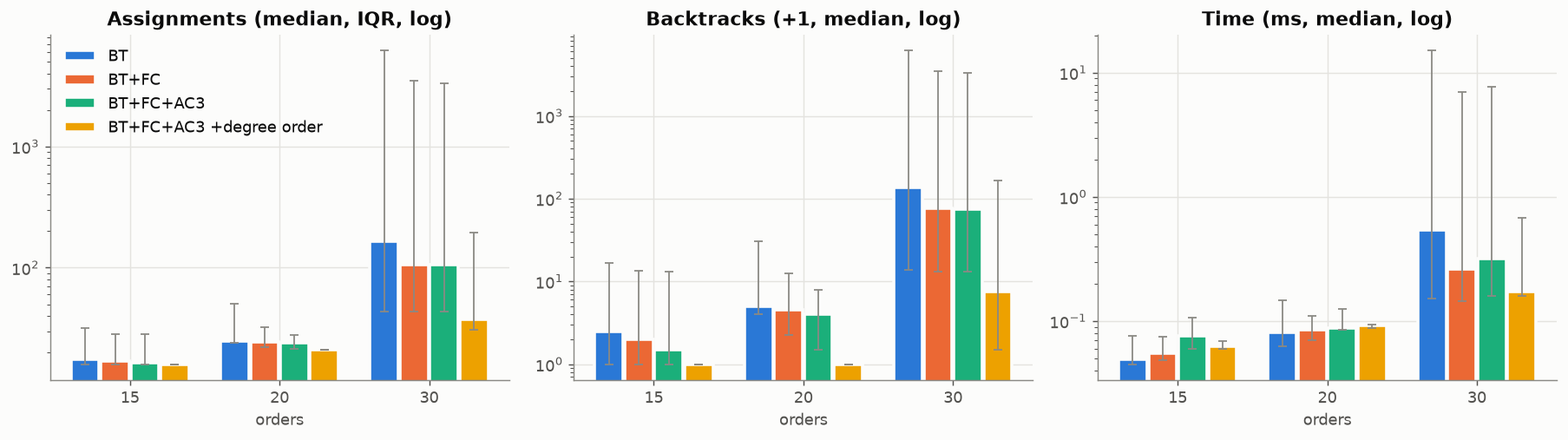
Pruning cuts the work 200×.
Hard rush-hour instance, 20 orders, assignments tried:
BT
4,136
BT + FC
1,701
+ AC-3
1,188
+ ordering
20
30 orders, median over 10 seeds: 166 → 106 → 105 → 37.
7Route searchAhmed
A* with an admissible time-dependent heuristic.
- State: (stop, visited set, clock). Cost: travel + waiting.
- The naive "cheapest trip at the current hour" is not admissible when traffic changes (counter-example: 40 > 35).
- Fix: minimum over all later departures, plus a waiting bound.
- Checked against brute force: 30 / 30 optimal.
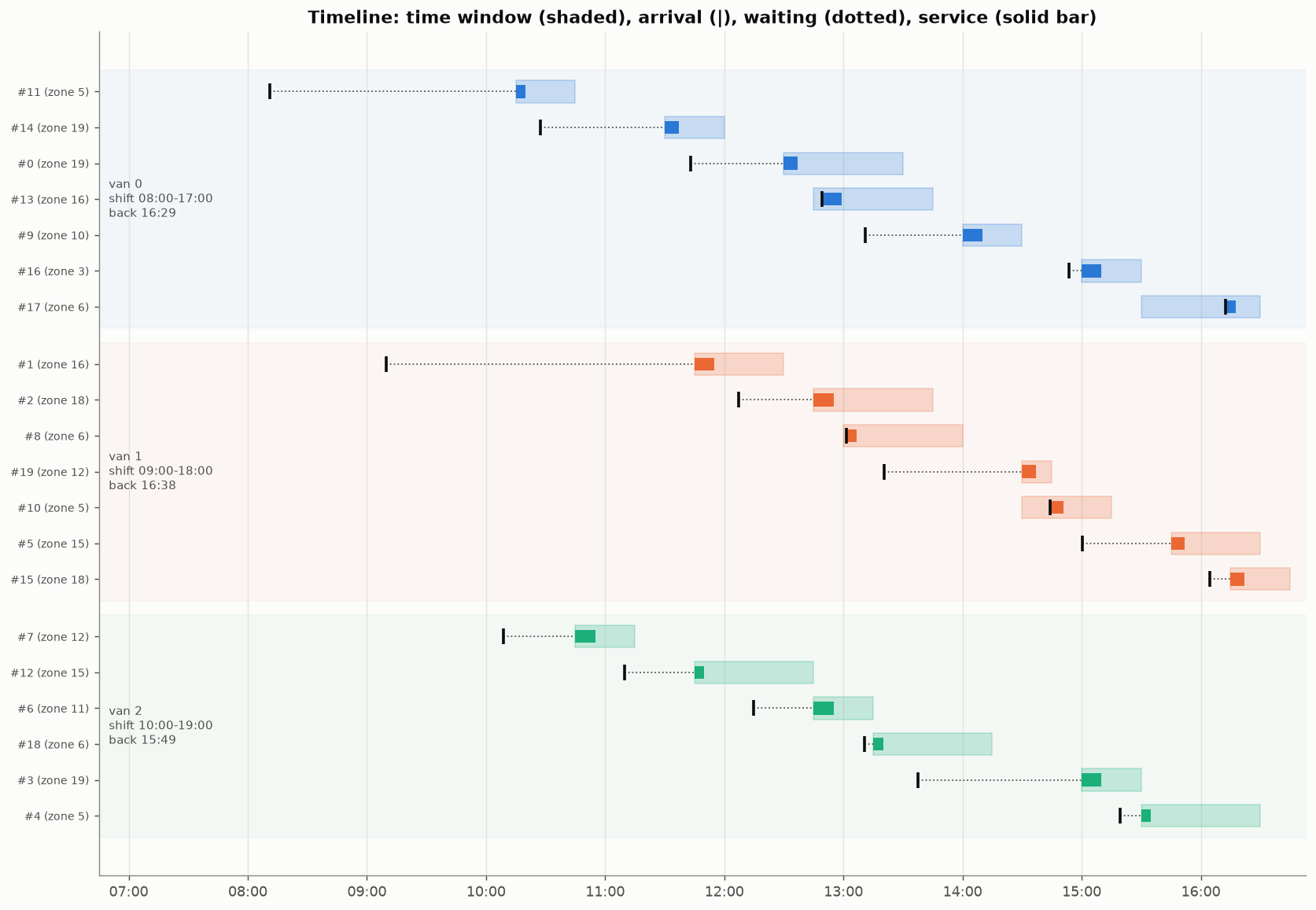
A* trace, van 0 (f = g + h, minutes)
#1 at depot visited [] g 0 h 461 f 461
#2 at 11 visited [11] g 140 h 321 f 461
#3 at 14 visited [14] g 217 h 244 f 461
#5 at 0 visited [0] g 277 h 184 f 461
#9 at 9 visited [11,14,9] g 370 h 91 f 461
f stays at 461: the bound is tight.
8Experiment 1: searchAhmed
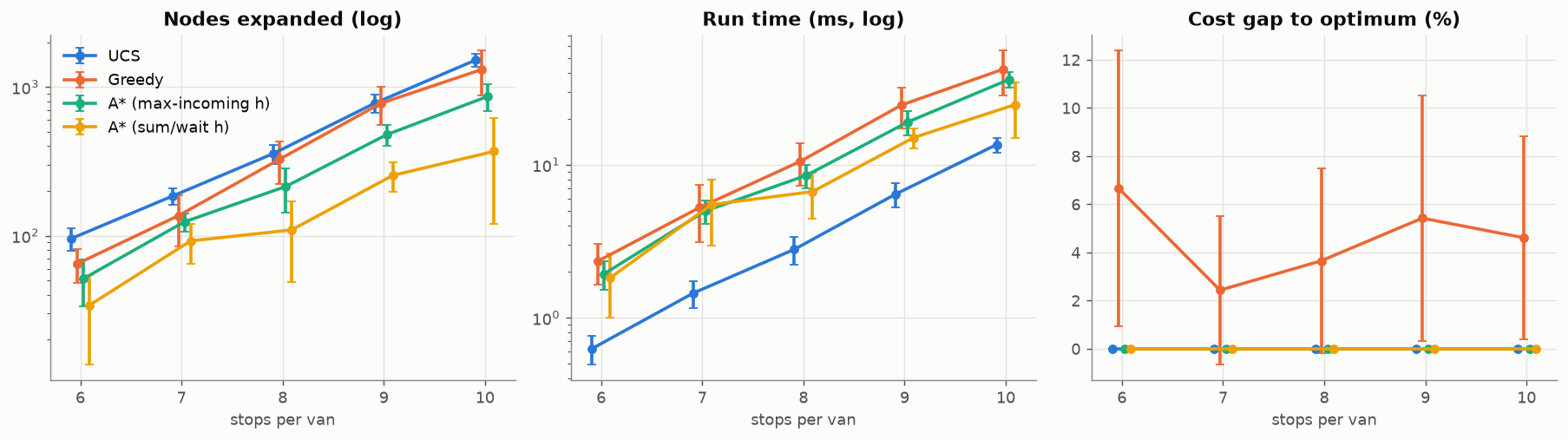
4.1× fewer nodes, same optimum.
369A* nodes expanded, 10 stops
1,519UCS nodes expanded
0%A* gap to optimum
4.6%Greedy gap, and not faster
9Integration and experiment 3Ahmed
A late route becomes a rule.
=== INTEGRATION LOOP (NN -> CSP -> A*)
loop 1: CSP solved (2 NN rules)
van 0 late by 2.1 min
-> new rule: orders 16 and 5
on different vans
loop 2: CSP solved (2 NN + 1 learned)
all 20 orders on time after 2 loops
Replay on real held-out trips, tight windows: share of deliveries late.
NN (MLP)
5.2%
Historical
5.1%
Distance
8.1%
10Limits and conclusionAhmed
Limits and conclusion.
- Taxi ≠ van: the 1.2 factor is an assumption.
- Mean times, no buffer: 1 to 8% still late in the replay.
- One month of data; no weather or seasons.
- Takeaway: hour-aware travel times + CSP + A* give on-time plans, provably optimal per van.
Live demo · 5 minutes
Thank you. Live demo.
python run_demo.py
python run_demo.py --impossible
python -m pytest -q # 38 passed
Full project page: p4.iqraxis.com